Hero
Strategic Briefing

Unit Economics — The Atomic Truth of Your Business Model

Unit economics strip away fixed costs to reveal the core viability of the business engine. Understand your revenue per unit minus variable cost per unit.

Audio Insight
Listen to the briefing
0:25
Download / Open Audio Audio failed to load. Please use Download / Open Audio.
SimplifyNumbers.com
Strategic Analysis | 2026 Edition

Unit Economics — The Atomic Truth of Your Business Model

Unit economics strip away fixed costs to reveal the core viability of the business engine. Understand your revenue per unit minus variable cost per unit.

Executive Summary

In today's competitive landscape, sustainable growth hinges on understanding your unit economics. You can't compensate for losses on individual units with increased volume. This analysis will expose the core levers influencing profitability and scalability, ensuring a resilient business model.

Primary Trigger
LTV/CAC < 1.25x
A ratio below 1.25 signals unsustainable customer acquisition costs. [NEEDS INPUT: Typical LTV/CAC ratio benchmarks].
Critical Metric
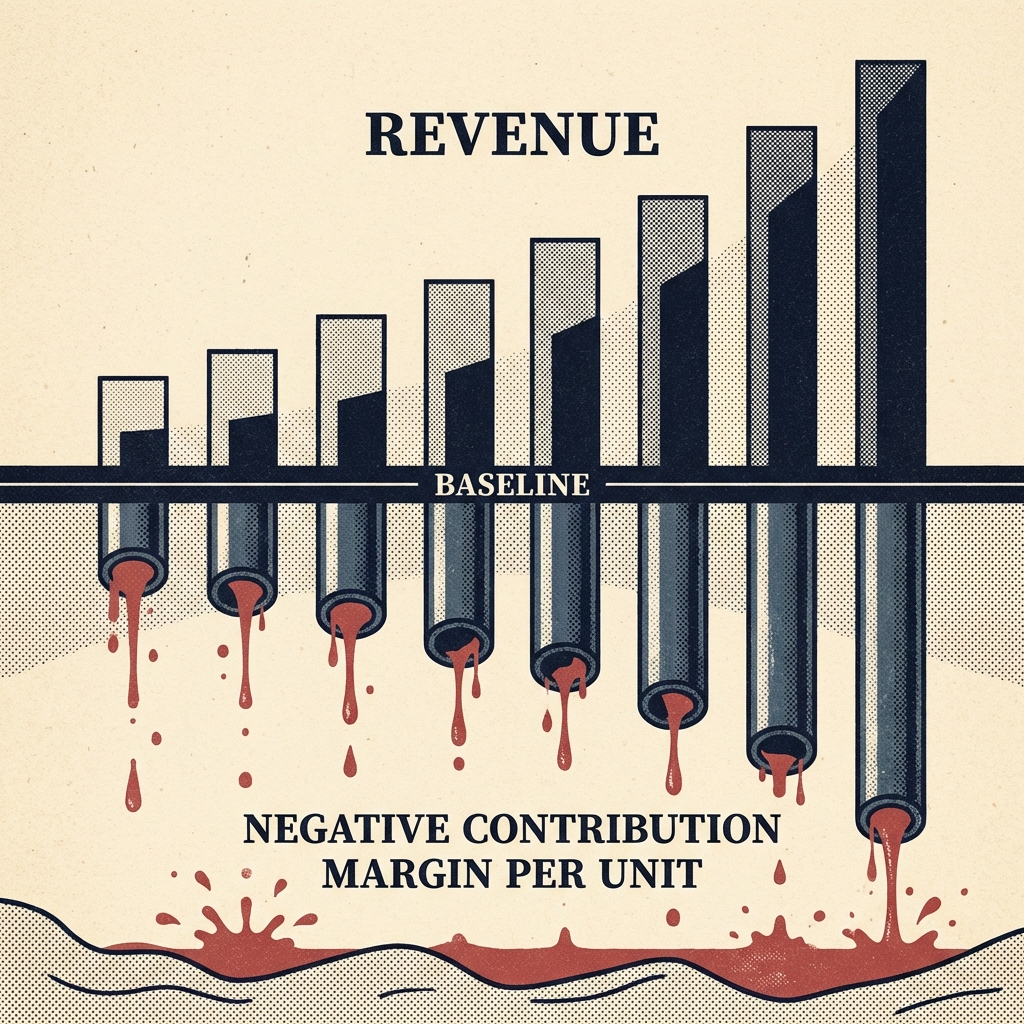
Negative Contribution Margin
Indicates that variable costs exceed revenue per unit, requiring immediate attention.
Hidden Danger
Blended Averages
Mask underlying problems with specific products or customer segments, leading to misinformed decisions.

Core Strategic Insight

The Thesis: The pursuit of scale without validated unit economics is a race to the bottom. Focus on profitability at the unit level before accelerating growth.

Diagnostic Analysis: The Mechanisms

Several mechanisms can erode unit economics, leading to unsustainable business models. Recognizing these traps is the first step toward recovery.

CAC Creep

Rising Customer Acquisition Cost

Increasing marketing spend without a corresponding increase in customer lifetime value (LTV) deteriorates unit economics. Explore alternative acquisition channels and optimize conversion rates.

Contribution Margin Leakage

Eroding Profitability Per Unit

Variable costs exceeding revenue per unit or decreasing contribution margin due to rising operational expenses destroy profitability. Scrutinize cost structures and pricing strategies.

Toxic Customer Acquisition

Acquiring unprofitable customers

Acquiring customers with low retention rates, high support costs, or low average order values degrades overall profitability. Improve customer segmentation and target ideal customer profiles.

Misleading Averages

Hiding unprofitable business segments

Combining products or customer segments obscures specific areas that are underperforming, leading to cross-subsidization and poor resource allocation. Disaggregate your analysis to expose outliers.

Strategic Implications

Failing to address unit economics undermines long-term sustainability and attractiveness to investors. Prioritize unit-level profitability to unlock scalable growth and build a resilient business.

Interactive Exhibits

Exhibit 1: Trend Analysis
Interactive Model
Hypothetical trend showing CAC increasing faster than LTV, indicating a deteriorating LTV/CAC ratio.
Exhibit 2: Strategic Matrix
Categorization
Scale & Profit Click for details
Optimize & Grow Click for details
Fix or Exit Click for details
Refine & Focus Click for details

Execution Roadmap

To improve your unit economics, implement these actionable steps:

1
Define Your Unit
Clearly define what constitutes a single 'unit' for your business (e.g., customer, order, subscription).
2
Calculate Contribution Margin
Determine revenue per unit and subtract all associated variable costs to find your contribution margin.
3
Analyze CAC
Calculate the fully loaded Customer Acquisition Cost (CAC), including all marketing and sales expenses.
4
Project LTV
Estimate Customer Lifetime Value (LTV) based on average customer lifespan and revenue per customer.
5
Segment Your Data
Analyze unit economics by product line, customer segment, and acquisition channel.
6
Identify Cost Drivers
Pinpoint the primary drivers of variable costs and CAC.
7
Optimize Pricing
Adjust pricing strategies to improve contribution margins, considering competitor pricing and value perception.
8
Reduce Variable Costs
Implement cost-saving measures to lower variable expenses per unit.
9
Improve Customer Retention
Implement strategies to increase customer loyalty and extend customer lifecycles.
10
Monitor and Iterate
Continuously track key unit economic metrics and adapt your strategies based on performance.