Audio Insight
Listen to the briefing
0:38
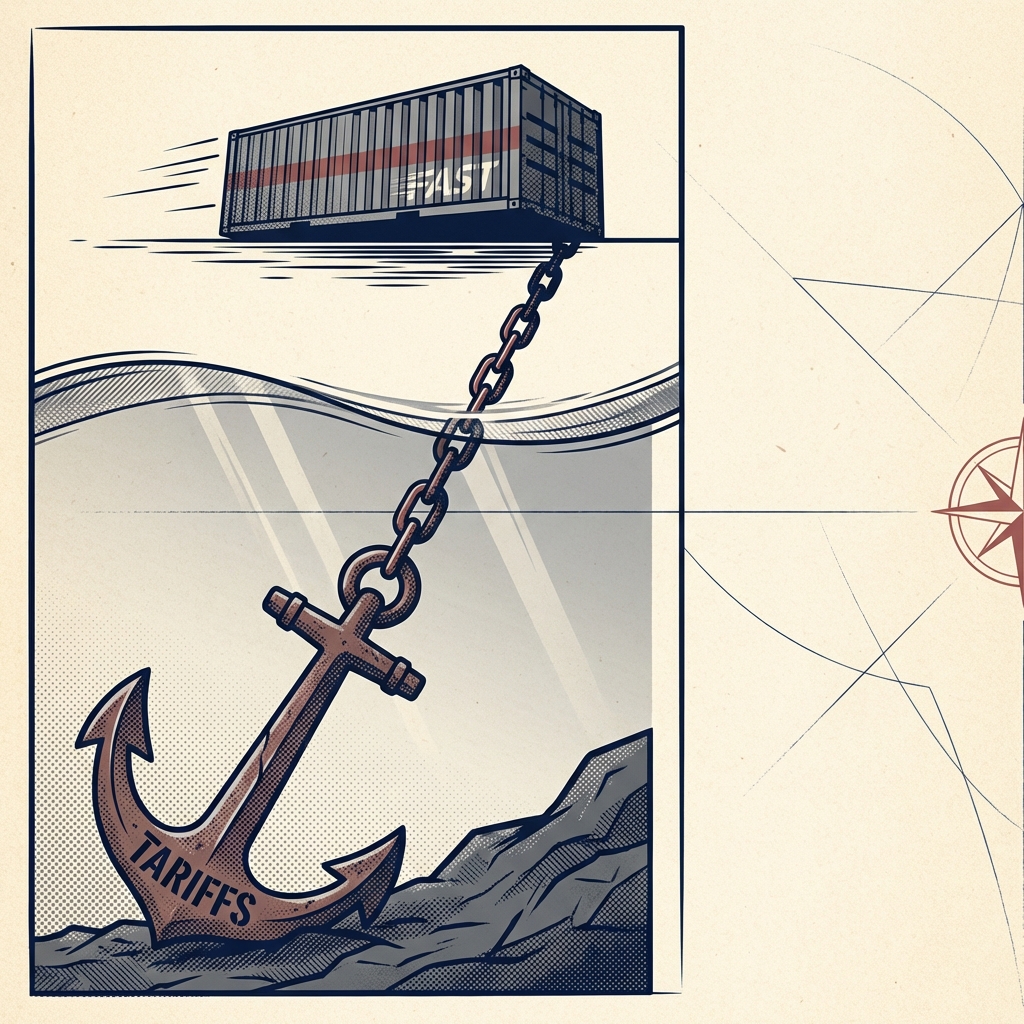
Tariffs Are a Hidden Tax: How They Hit Margin and Cash Before Leaders Notice
Tariffs and trade frictions often show up as cost increases, delays, and pricing
pressure across the chain. This briefing provides a “Pass-Through Ladder” and a tariff-proofing
playbook for SMEs.
Executive Summary
Tariffs and trade friction introduce hidden taxes that can erode SME profitability and strain
cash flow long before traditional financial metrics reflect the impact. This briefing unpacks
the 'Pass-Through Ladder,' illustrating how these costs propagate through the supply chain and
manifest as margin compression, working capital challenges, and pricing pressures. A practical
playbook of ten actions is included to help SMEs build resilience and optionality, mitigating
tariff-related risks.
Primary Trigger
Supplier Cost Increase
Tariffs often manifest first as a cost increase from suppliers, affecting SMEs
indirectly.
Critical Delay
Cash Conversion Cycle Lag
Cost shocks typically arrive before pricing adjustments can be made, creating
a timing mismatch.
Hidden Impact
Working Capital Strain
The cash impact often comes from inventory, delays, and overall working
capital strain.
Core Strategic Insight
The Thesis: Even if you do not import directly, tariffs and trade friction can
move through your suppliers into your cash flow. The key is to build resilience and optionality,
not perfect prediction.
Diagnostic Analysis: The Mechanisms
Tariffs and trade friction can impact SMEs through several mechanisms, creating hidden costs and
operational challenges. Recognizing these 'traps' is the first step toward building a robust
defense.
Supplier Shock
Indirect
Exposure
Many SMEs are indirectly exposed to
tariffs through their suppliers' increased costs, regardless of direct import activity.
This often arrives with little warning.
Pricing Lag
Margin
Compression
The time it takes to adjust pricing in
response to cost increases creates a margin squeeze, especially in competitive markets
where immediate price hikes are not feasible.
Inventory Pileup
Working
Capital Drain
Uncertainty around tariffs can lead to
increased inventory buffers, tying up working capital and increasing storage costs.
Conversely, disruptions can lead to shortages.
Contractual Risks
Terms and
Conditions
Existing contracts may not adequately
address tariff-related cost increases or supply disruptions, leaving SMEs vulnerable to
unfavorable terms and conditions.
Strategic Implications
SMEs must shift from a reactive to a proactive stance on tariffs, focusing on supply chain
resilience, pricing agility, and cash flow protection. This requires a holistic approach that
considers both direct and indirect exposures, as well as the timing mismatch between cost increases
and pricing adjustments.
Interactive Exhibits
Exhibit 1: Trend Analysis
Interactive Model
HYPOTHETICAL: Gross profit and cash balance declining over time due to
increasing tariff-related costs and delayed price adjustments.
Exhibit 2: Strategic Matrix
Categorization
React & Absorb
Click for details
Price Hike & Pray
Click for details
Streamline & Absorb
Click for details
Diversify & Defend
Click for details
Execution Roadmap
To 'tariff-proof' your SME, consider these 10 actionable steps. Implement these actions starting
Monday to build resilience.
1
Map Your Exposure
Identify all direct and indirect suppliers potentially affected by
tariffs. (Map your exposure (direct + indirect suppliers))
2
Cost-Change Alerts
Establish a process with suppliers for early warnings of cost changes.
(Build a cost-change alert process with suppliers)
3
Pricing Governance
Tighten pricing governance to ensure timely and appropriate repricing.
(Tighten pricing governance (when and how you reprice))
4
SKU Rationalization
Reduce fragile SKUs and simplify your product assortment. (Reduce fragile
SKUs; simplify assortment)
5
Renegotiate Terms
Renegotiate lead times, MOQs, and payment terms with suppliers.
(Renegotiate terms (lead times, MOQs, payment terms))
6
Dual-Source
Explore dual-sourcing options to reduce single-point disruption risk.
(Dual-source where feasible (without overpaying blindly))
7
Inventory Stress-Test
Stress-test inventory buffers to optimize levels for different scenarios.
(Stress-test inventory buffers (too little vs too much))
8
Communicate Early
Communicate proactively with customers about potential price adjustments.
(Communicate early with customers (avoid surprise repricing))
9
Protect Cash
Shorten receivables and improve cash conversion cycles. (Protect cash:
shorten receivables where possible)
10
Scenario Triggers
Develop scenario-based triggers for specific actions. (Build scenario
triggers (if X happens, do Y))